

Setting up a recording space in a small room can be tough. But, with the right steps, you can make high-quality recordings. I’ve worked with many setups and know that a dedicated space boosts your podcast equipment performance.
Small rooms often have bad acoustics. Small room acoustics are hard to fix, but knowing the basics helps. By improving your room’s sound and picking the right tools, you can get professional sound.
By the end of this article, you’ll know how to make a great recording space in a small room. This will improve your recording quality.
Key Takeaways
- Understand the importance of a dedicated recording space
- Learn how to optimize your small room’s acoustics
- Discover the right podcast equipment for your needs
- Improve your recording quality with simple adjustments
- Create a professional-sounding podcast in a small room
Understanding the Challenges of Small Room Acoustics
Small rooms can make podcast recording tough. Sound acts differently in tight spaces than in big, open ones.
Common Acoustic Problems in Small Spaces
Echo and reverberation are big issues in small rooms. Sound waves bounce off walls, floor, and ceiling. This creates a mix of reflections that can mess up your recording.
Producer and sound engineer, Sylvia P. Nester, once said,
“The acoustics of a room can either enhance or detract from the quality of your recording; it’s crucial to understand how to work with the space you have.”
How Sound Behaves in Confined Areas
In small rooms, sound waves don’t have room to spread out. This leads to a buildup of reverberant energy. This can make your sound unnatural, boomy, or overly resonant.
The Importance of Proper Setup for Quality Recording
Getting your setup right is key for quality recordings in small rooms. You need the right gear and to place it strategically. This helps to reduce the room’s acoustic impact.
By setting up your space well, you can greatly improve your podcast’s sound. Understanding and tackling these challenges is vital for podcasters in small rooms. With the right strategies, you can make your podcast sound professional, even in tight spaces.
Assessing Your Available Space
Understanding your available space is key to creating an effective recording environment. To start, you need to have a clear understanding of the room’s dimensions and layout.
Measuring and Mapping Your Room
Begin by measuring the length, width, and height of your room. Use a tape measure to get accurate dimensions. It’s also helpful to create a simple floor plan or map of your space, noting the location of doors, windows, and any fixed objects.
Identifying Potential Problem Areas
Identify areas that could cause acoustic issues, such as reflective surfaces, corners where sound can build up, and any gaps or cracks. Being aware of these potential problem areas will help you plan your recording setup and any necessary acoustic treatments.
Choosing the Optimal Recording Position
Decide on the best position for your microphone and recording equipment. Generally, placing your microphone away from reflective surfaces and corners can help reduce echo and sound reflections.
| Room Feature | Potential Issue | Solution |
|---|---|---|
| Hard Floors | Echo and reverberation | Add area rugs or carpets |
| Parallel Walls | Sound reflections | Use acoustic panels or diffusers |
| Corners | Bass build-up | Install bass traps |
Essential Podcast Equipment for Small Recording Spaces
Creating a great podcast in a small room starts with the right equipment. You need to pick items that are both functional and high-quality, even when space is tight.
Microphones Ideal for Limited Space
In small spaces, you need compact microphones. The Blue Yeti is a top pick for podcasters. It’s a USB mic that connects easily to your computer, perfect for solo shows or small setups.
The Rode NT-USB is another great choice. It offers studio-quality sound in a small package. These microphones save space while delivering top-notch audio for your listeners.
Compact Audio Interfaces and Mixers
For audio interfaces, the Focusrite Scarlett series is a top pick for small spaces. They provide excellent sound quality and are built to last.
The Behringer Xenyx Q802USB mixer is a budget-friendly option for podcasting. It’s compact and meets the needs of solo or multi-person recordings.
Headphones and Monitoring Solutions
Quality headphones are key for monitoring your audio. The Sony MDR-7506 is a favorite among podcasters. It delivers clear, accurate sound.
For monitoring, consider the KRK RP5 G3 speakers. They’re small but designed for precise monitoring.
Space-Efficient Accessories and Stands
Don’t overlook accessories like pop filters and shock mounts. They improve your recording quality. Brands like Rode and Blue offer compact, functional accessories.
With the right equipment, you can make a professional-sounding podcast, even in a small space.
Designing Your Small Recording Space Layout
To make the most of your small recording space, planning its layout is key. A well-thought-out space can greatly enhance your recordings. It does this by reducing echo and sound reflections.
Optimal Furniture Arrangement
It’s important to arrange furniture to cut down on sound reflections. Place your recording gear away from hard walls or glass. Soft items like carpets and curtains can also soak up sound.
Tips for Optimal Furniture Arrangement:
- Put your desk or recording area in a corner to lessen echo.
- Use a rug to catch sound reflections from the floor.
- Hang curtains or sound-absorbing panels on walls.
Creating Dedicated Zones
Setting up different zones in your small recording space helps keep it tidy and functional. Make areas for recording, editing, and storing equipment.
Benefits of Dedicated Zones:
- It makes your workflow smoother during recording and editing.
- It cuts down on clutter and makes cable management easier.
- It helps you focus on tasks without getting distracted.
Cable Management in Tight Quarters
Good cable management is vital in a small recording space. Organizing cables not only keeps things tidy but also protects your gear.
Cable Management Tips:
- Use cable ties or zip ties to bundle cables.
- Label your cables so you can tell them apart.
- Run cables behind furniture or through cable management boxes.
Budget-Friendly Acoustic Treatment Options
Creating a professional-sounding podcast in a small room doesn’t have to be expensive. With a few affordable acoustic treatments, you can greatly improve your recording’s sound quality.
Understanding Acoustic Panels and Their Placement
Acoustic panels are key in controlling echo and reverberation in your recording space. They absorb sound energy, reducing reflections that can cloud your audio. Place acoustic panels in areas where sound reflections are most common, like between your microphone and the wall, or on ceilings and corners.
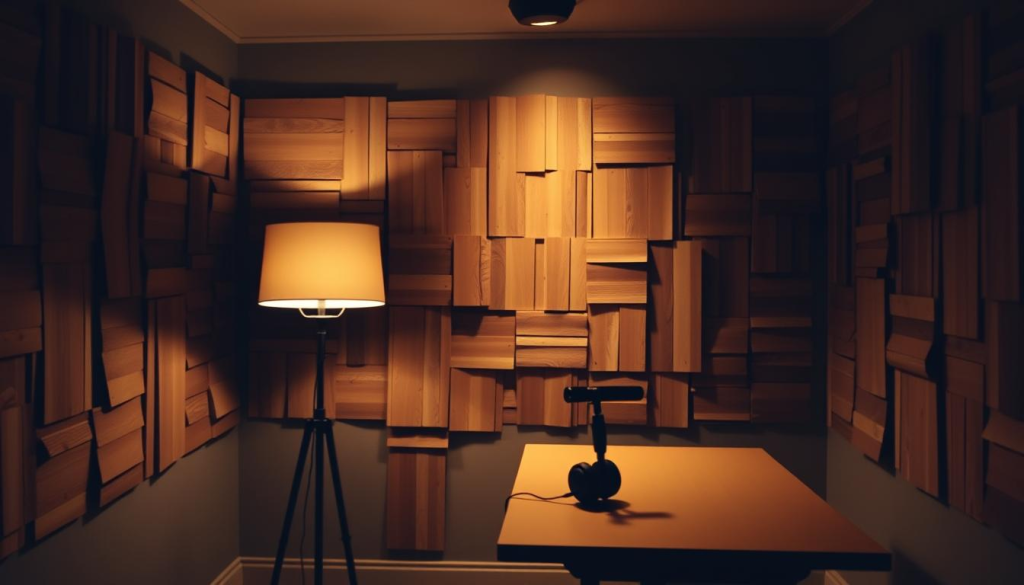
Bass Traps for Small Rooms
Bass traps are special acoustic treatments for low-frequency energy. In small rooms, they help reduce the boomy or resonant sound that often affects recordings. You can buy or make bass traps and put them in corners where low-frequency energy builds up.
Diffusers vs. Absorbers: What You Actually Need
Diffusers scatter sound in different directions, while absorbers soak up sound energy. For most podcasting, absorbers are better as they cut down echo and reverberation. But, if you have a bigger space or are recording complex audio, diffusers can help keep a natural ambiance.
Affordable Commercial Solutions
There are many affordable commercial acoustic treatments available. Look for brands like Auralex Acoustics or GIK Acoustics, which offer budget-friendly options. You can also use materials like Owens Corning 703 or Roxul Safe’n’Sound for DIY acoustic panels.
By using these affordable acoustic treatments, you can improve your podcast’s sound quality without spending too much. Start with the basics and adjust as needed based on your recording environment.
DIY Soundproofing Techniques for Small Rooms
Improving your small room’s recording quality is easy with DIY soundproofing. It doesn’t have to cost a lot or be hard. I’ve worked in many recording spaces and know it’s possible.
Creating Homemade Acoustic Panels
Making your own acoustic panels is a great DIY project. Use Owens Corning 703 or Roxul Safe’n’Sound insulation. Then, wrap it in burlap or cotton. Hang these panels on walls or ceilings to cut down on echo and sound bounce.
Repurposing Household Items for Sound Treatment
Improving your room’s sound can be done with items you already have. Hang thick blankets or quilts on walls to absorb sound. Or, make bass traps with cardboard boxes and insulation.
Weekend Projects to Improve Room Acoustics
There are many weekend projects to boost your room’s sound. Building a diffusion panel with plywood and wooden slats is one. You can also make a portable vocal booth with PVC and fabric.
Temporary Solutions for Renters
Even renters can do DIY soundproofing without harming their space. Use removable hooks for acoustic panels or thick curtains. Portable solutions like vocal booths or isolation shields also work well.
| DIY Project | Materials Needed | Benefits |
|---|---|---|
| Homemade Acoustic Panels | Insulation material, breathable fabric | Reduces echo and reverberation |
| Repurposed Household Items | Thick blankets, cardboard boxes, insulation | Cost-effective sound absorption |
| Diffusion Panels | Plywood, wooden slats | Improves sound diffusion and quality |
With these DIY soundproofing tips, you can make your small recording space sound better. This will help you record podcasts that sound great.
Optimizing Microphone Placement and Accessories
Setting up your microphone right is key to a great podcast recording space, even in small rooms. Knowing how to place your microphone and using the right gear is crucial. This helps you get high-quality recordings.
Finding the Sweet Spot in Your Room
The “sweet spot” is where your microphone picks up your voice best, with little background noise. In small rooms, this spot is usually in the room’s center, away from walls and corners. Try different spots to find the perfect one.
Using Pop Filters and Shock Mounts Effectively
Pop filters and shock mounts are essential for better recordings. Pop filters cut down on plosive sounds that can mess up your mic. Shock mounts keep your mic steady, reducing vibrations and handling noise. Together, they make your recordings clearer.
Dealing with Reflective Surfaces
Reflective surfaces in small rooms can cause echo and affect your recording. Use acoustic panels or DIY solutions like blankets to soak up sound. Also, place your microphone to avoid picking up reflections.
Microphone Techniques for Small Spaces
Choosing the right microphone techniques is vital in small spaces. Use directional mics like cardioid or supercardioid to focus on your voice. Also, keep a steady distance from the mic and speak across it to cut down on plosive sounds.
| Microphone Technique | Description | Benefit |
|---|---|---|
| Cardioid Pickup Pattern | Captures sound from the front, rejects from the back | Reduces background noise |
| Speaking Across the Mic | Reduces direct airflow onto the mic | Minimizes plosive sounds |
| Consistent Mic Distance | Maintains a steady distance from the mic | Ensures consistent sound quality |
By optimizing your microphone setup and using the right accessories, you can greatly improve your podcast’s sound quality, even in small rooms.
Solutions for Multi-Person Podcasting in Limited Space
Recording podcasts with many people in small spaces needs creative solutions. It’s key to set up your recording area well for everyone involved.
Arranging Multiple Recording Positions
To fit many hosts or guests, arrange them in a circle or semi-circle. This helps avoid echo and sound reflections. Using directional microphones also helps get clear audio from each person.
Equipment Sharing Strategies
Sharing equipment in a small space is smart. Use multi-channel audio interfaces to connect multiple microphones. This lets each person have their own mic.
Creating Separation Without Physical Barriers
To cut down on microphone bleed, use pop filters. Also, place microphones to block sound from others. Adjusting microphone gain helps reduce bleed too.
Remote Co-hosting Alternatives
If space is really tight, try remote co-hosting. Record people from afar and sync the recordings later. It takes more editing, but it works in small spaces.
With these tips, you can record great podcasts with many people, even in tiny spaces.
Testing and Optimizing Your Small Recording Space
Testing your small recording space is key to making great recordings. After setting up your gear and space, make sure it sounds perfect.
Simple Room Tests to Perform
Begin by clapping your hands or popping a balloon to check for echo. Record yourself talking and listen back to spot any echo or boom.
Making Adjustments Based on Test Results
If you find a lot of echo or reverberation, think about adding DIY soundproofing like acoustic panels. You could also move furniture to cut down on reflective surfaces.
Fine-Tuning Your Setup Over Time
Keep an ear out for sound quality changes as you record more. You might need to adjust microphone placement or add more sound treatment.
When to Consider Professional Help
If you’ve tried many tweaks but still face sound issues, it’s time to get expert advice. A pro can give you specific tips for your space.
| Test | Purpose | Potential Solution |
|---|---|---|
| Clap test | Identify echo | Add acoustic panels |
| Recording test | Assess sound quality | Adjust microphone placement |
Conclusion
Creating a podcast recording space in a small room needs careful planning. You must understand the challenges of small room acoustics. Also, picking the right podcast equipment and designing a good layout are key.
I’ve talked about ways to improve your recording space. This includes assessing and optimizing your room’s acoustics and choosing the best equipment. These steps will help you get professional-sounding recordings, even in a small space.
As you work on your recording setup, remember to test and optimize your space. By using the tips and techniques I’ve shared, you can make a high-quality recording environment. This will make your podcast better and keep your audience engaged.